
NEWS & DEVELOPMENTS

Social housing allocations in England prioritise urgent needs, but many households on registers lack urgent need. There is a need to improve housing standards and better understand housing needs.
Social housing allocations law in England gives people with certain housing needs a reasonable preference for social housing. These include:
Having a reasonable preference doesn’t guarantee priority over others on a housing register, but is intended to increase the likelihood of being selected for an allocation of social housing. It is supposed to allow people with urgent housing needs a fair advantage over those with less urgent needs.
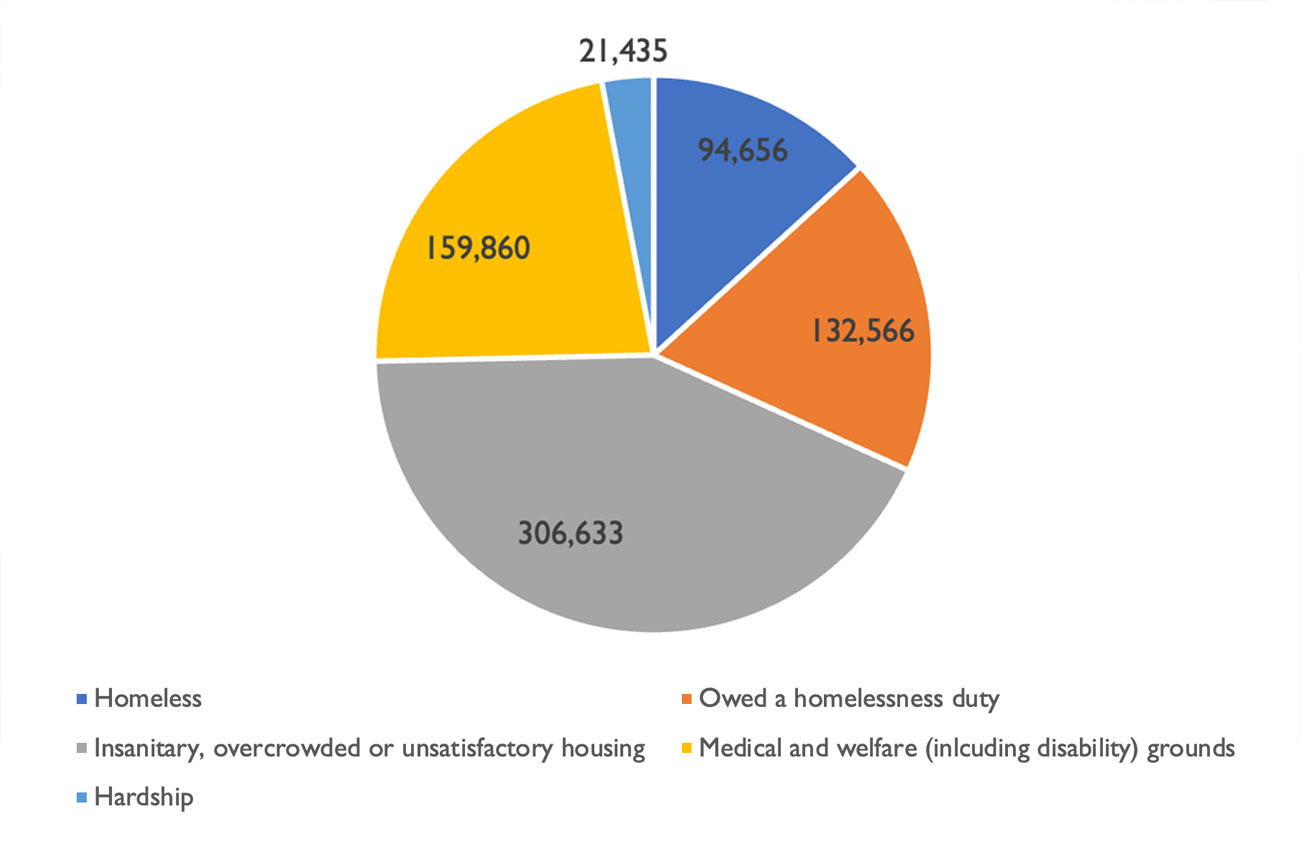
As of March 31, 2025, 1.3 million households were on social housing registers in England, with 48% in a reasonable preference category. Housing register statistics are based on a snapshot taken on March 31st each year, submitted by local authorities in spring/summer, and published by the Ministry of Housing, Communities and Local Government in autumn.
The data shows that, albeit local authorities have powers to set a qualifying criterion, and fears that it would become common to disqualify anyone without a reasonable preference, this has not happened. Just over half of our households on housing registers are not in a reasonable preference category.
Nearly half of all households with a reasonable preference were due to living in innsanitary, overcrowded, or otherwise unsatisfactory housing conditions, about twice as many as those owed a homelessness duty or needing to move for medical or welfare reasons, about three and a half times as many as those homeless, and about 15 times as many as those needing to move to avoid hardship.
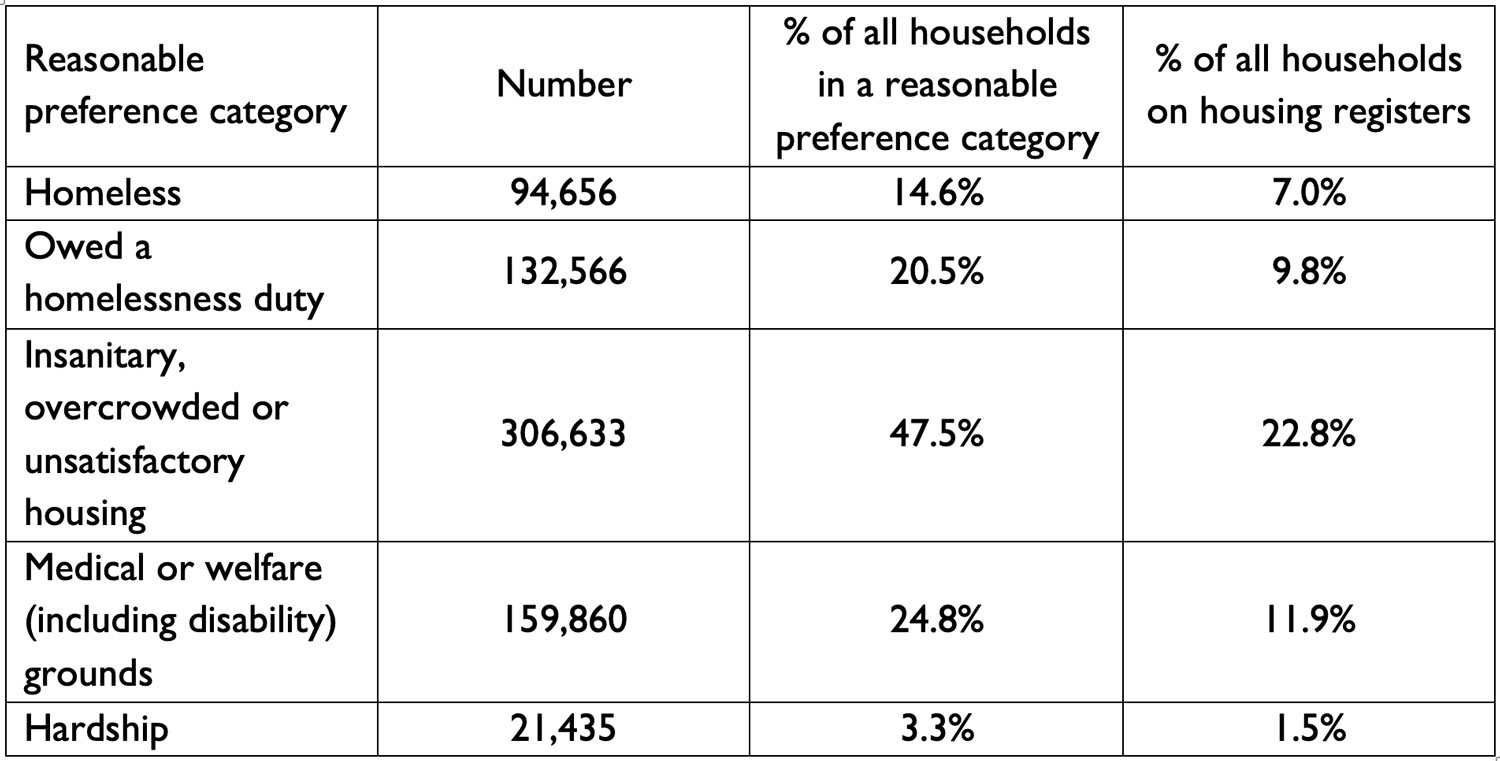
Households experiencing homelessness made up 1/7 of those in a reasonable preference category and 1/14 of those on housing registers. Housing register statistics don’t show the type of homelessness a person is experiencing, so it’s unclear how many households in this category are street homelessness, hidden homelessness, or experiencing another form of homelessness.
Households owed a homelessness duty accounted for 20% of households in a reasonable preference category and just under 10% of those on housing registers. Housing register statistics doesn't show the type of homelessness duty owed to those in this category. Homelessness statistics, published separately quarterly and annually, show slightly fewer households are owed a prevention duty (45%) than a relief duty (55%), with those owed the main duty equating to 40% of those owed a relief duty. Based on this data, it could be assumed that of those households in a reasonable preference category due to being owed a homelessness duty, just over one-third are owed a prevention duty, just under one-half are owed a relief duty, and about one-fifth are owed the main duty. A snapshot of homeless households occupying temporary accommodation on 31st March is taken annually, similar to the method used for collecting data about households on housing registers. On 31st March 2025, 130,890 households were in temporary accommodation, 1.3% lower than the number of households on housing registers owed a homelessness duty on the same date. However, these statistics don’t necessarily correlate, as not every household occupying temporary accommodation will be on a housing register, and those on a housing register entitled to a reasonable preference due to being owed a homelessness duty will be owed all types of homelessness duties, including the prevention duty, when they’re unlikely to be occupying temporary accommodation. Therefore, no exact comparison can be made between housing register statistics and homelessness statistics to determine the types of duties owed to people on a housing register in a reasonable preference category due to being owed a homelessness duty.
Half of all households in a reasonable preference category and just under a quarter of those on housing registers needed to move due to occupying innsanitary, overcrowded, or living in otherwise unsatisfactory housing condition. While housing registered statistics don’t include the number or proportion of people who need to move due to living in such conditions, the amount of households needing housing due to these conditions indicates the extent of the intolerable living conditions and the unsuitable standard of housing stock across the country. This emphasises the importance of ensuring all housing, social and private, meets the decent homes standard and extending the standard to the private rented sector can't come soon enough. Regulatory oversight and enforcement action are crucial to ensure landlords provide and maintain adequate housing standards.
Households needing to move due to medical, welfare, or disability grounds made up 1/4 of households in a reasonable preference category and just over 1/10 of those on housing registers. Housing register statistics are collected on the number or proportion of people needing to move for these reasons, nor on the types of grounds causing the move. This makes it hard to understand how social housing helps health and social care services fulfil their duties to vulnerable adults. More data on the types of grounds causing moves would help inform the types of social housing needed, especially accessible housing for disabled people. YouGov research for the Equality and Human Rights Commission found that about 400,000 disabled households live in housing that is not accessible for their disability (about three times more than the number of homeless households in temporary accommodation), compromising their ability to live safely and with dignity.
Households needing to move to a particular locality in a local authority district because failing to meet that need would cause hardship, made up 1/30 of households in a reasonable preference category and 1/100 of those on housing registers. Housing register statistics aren't collected on the nature of the hardship causing the move, making it hard to understand what type of housing might be needed and how to prevent such needs from occurring.
Social housing allocations in England prioritise certain groups for urgent housing needs, with the intention to ensure they receive an allocation of social housing before others with less urgent needs. Nearly half of the 1.3 million households on housing registers in England on 31 March 2025 were in a reasonable preference category, mainly due to unsatisfactory housing conditions. Many households on housing registers do not have an urgent need for social housing. The prevalence of households with reasonable preference who are inadequately housed hlights the need to improve housing standards. Better data is needed on the reasons for moving due to inadequate housing standards and a better understanding of housing needs related to medical, welfare, and hardship reasons.
